2026 Political Marketing Trends: Why This Election Season Isn’t Like Any Other
How campaign teams are rethinking political advertising for a faster, more fragmented voter landscape.
Writer: Phil Vavelidis
Date: August 20, 2026
Estimated reading time: 5 minute read
What you’ll learn:
- Why same-day activation helps campaigns respond quickly to fast-moving political moments and voter needs.
- How precision targeting helps campaigns reach voters in the locations that matter most.
- Why geolocation targeting is currently capturing a growing share of political advertising budgets.
- How political data providers help campaigns extend reach beyond existing voters and engage new audiences.
- What to look for in a political advertising partner built for speed, precision, and scale.

Today’s digital world moves fast; news shifts by the hour, audiences form opinions while scrolling on social media, and yes, some voters are now asking their favorite AI tool, “hey, who should I vote for?” (Not quite that literal, but we’re not far off!)
For anyone running political advertising in 2026, the market has never faced this many simultaneous challenges: fragmented audiences, shrinking attention spans, and political opinions that are shaped across more channels, platforms, and AI-powered experiences than ever before. This is making it harder for marketers and campaign managers to know where their audiences are, and even harder to reach them fast enough to influence the conversation.
Adding to the complexity, political advertising campaigns operate under legal limitations, tight geographic boundaries, and overnight expectations. Get the ad live right after the debate. No excuses, no delays, and frankly, no detail is up for debate (pun intended).
THE NEW REALITY OF POLITICAL ADS: SPEED, PRECISION, AND PROOF
Every election cycle, the same three demands resurface for political advertising: move faster, target tighter, and prove it worked.
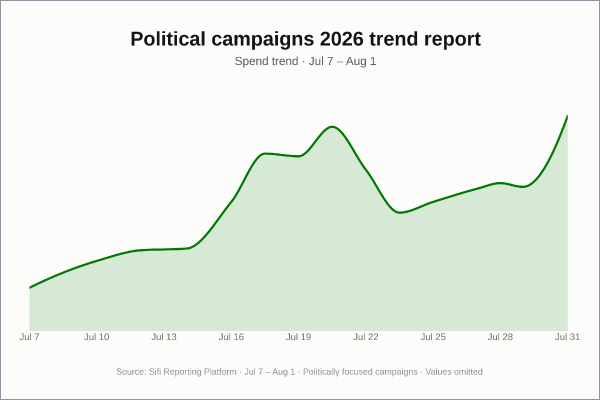
As the trendline on the right illustrates, political advertising activity is already accelerating ahead of the 2026 election cycle, giving campaigns less time than ever to respond to changing voter sentiment and sudden events.
Political news cycles turn over in hours, not days. Voters expect political commercials, digital pre-roll, and connected TV spots to reflect what just happened, not what happened last week. And with tightening budgets and increased scrutiny, every dollar of campaign ad spend needs to show measurable return.
SAME-DAY ACTIVATION IN A FAST-PACED POLITICAL LANDSCAPE
In a cycle where a single debate, headline, or scandal can reshape a race overnight, campaigns don’t have the luxury of a multi-day ad approval and launch process. Same-day activation has become one of the most important capabilities in modern political advertising, letting teams respond to breaking news moments, such as a debate performance, a news cycle shift, or a late endorsement, while it’s still relevant to voters.
This kind of speed also opens the door to incremental reach: the ability to extend a message beyond a campaign’s existing voter file by tapping into political data providers and layering in new, qualified audiences on the fly. Rather than waiting on a media plan to catch up to the news, campaigns can pivot in near real time to stay relevant and still follow the guardrails of advertising and political compliance.
FURTHER READING:
The Final Stretch: Boosting Political Campaigns with Same-Day Activation and Incremental Reach
PRECISION TERRITORY TARGETING: ADDRESS-BASED GEO-FENCING FOR POLITICAL CAMPAIGNS
Few things matter more in a political race than territory. Congressional districts, precincts, and even individual polling locations all carry different messages, different candidates, and different stakes. Generic geographic targeting (zip codes, DMAs, broad radius targeting) simply isn’t precise enough anymore.
Address-Based Geo-Fencing and detailed geolocation targeting solves that problem by allowing campaigns to define political territory down to specific addresses, buildings, and points of interest. Think early voting sites, town halls, rally venues, or even a competing candidate’s event. Layer in addressable targeting, and campaigns can reach specific households and voter segments directly, instead of relying on broad geographic targeting.
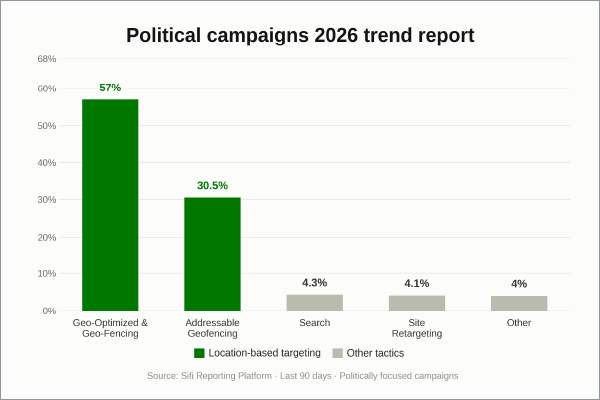
The data backs this up: in a review of active political client campaigns over the last 90 days, Geo-Optimized and Address-Based Geo-Fencing tactics weren’t just popular; they were the two highest-spending tactic categories by a wide margin, together accounting for well over three-quarters of all political ad dollars tracked. That’s not a coincidence. Campaign budgets are casting a clear vote for precision.
FURTHER READING:
What Is Addressable Targeting? Learn How It Can Work for You
WHAT THE DATA SAYS ABOUT POLITICAL ADVERTISING RIGHT NOW
Active political client performance across the last 90 days tells a clear story about where current political ad dollars are going and what’s working:
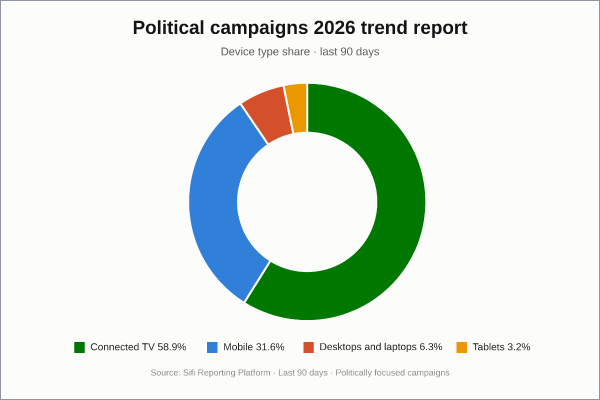
- Connected TV and mobile are the battleground devices. Nearly 59% of device spend is going to Connected TV, with mobile close behind at just under 32%; a reminder that the best political billboards of this cycle aren’t on the roadside, they’re on the living room screen and the device in a voter’s pocket.
- Geo-Optimized and Address-Based Geo-Fencing dominate tactic spend, together representing the majority of political ad investment, proof that precision targeting is winning out over broad-reach buys.
- Search remains the most efficient tactic by profit margin, reinforcing that intent-based targeting still plays a critical role even in a video and CTV-heavy political media mix.
For any team benchmarking their own best political ads strategy, these patterns offer a useful gut check: is your media mix built for where and how voters are actually watching, or where they used to?
FURTHER READING:
2026 Trends: Omnichannel and Political — The Pressure Test Year
Engaging Political Influence Beyond the Voter
HARNESSING INCREMENTAL REACH WITH POLITICAL DATA PROVIDERS
Precision targeting is only half the equation; reach is the other half. Political data providers give campaigns a way to extend beyond their known voter universe and find persuadable or unregistered-but-likely voters who wouldn’t otherwise show up in a standard file.
Combined with same-day activation, this lets political campaign ads find new, qualified audiences without sacrificing the speed a campaign needs in the final stretch.
AN AWARD-WINNING POLITICAL SERVICE TEAM
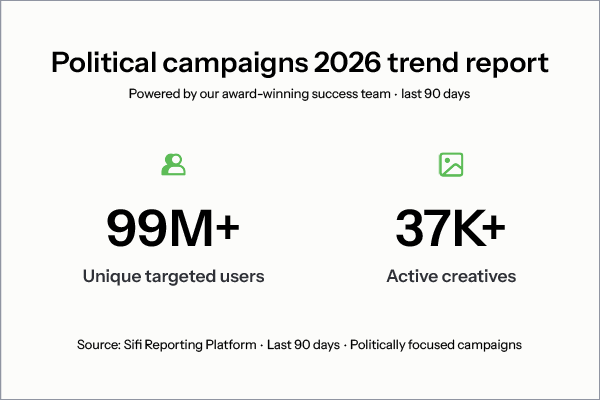
Technology and data are only as good as the team behind it. As winners of the Best Political Service Team category at the Campaigns & Elections Reed Awards, Simpli.fi has built a client success team that specifically caters to the pace and pressure of political advertising.
In a season where a single missed launch window can cost a campaign its moment, having a support team that understands political deadlines, compliance requirements, and rapid-response media buying isn’t a nice-to-have. It’s the difference between a political advertising firm that just runs ads and one that runs a campaign’s media strategy alongside them.
Choosing the Right Partner for Political Campaign Ads
With so many political advertising companies competing for campaign budgets this cycle, the differentiator isn’t just inventory access; it’s the combination of speed, targeting precision, incremental reach, and a support team that’s been recognized for doing it well. Campaigns evaluating a political marketing agency for Q3 and Q4 2026 should be asking:
- Can this partner activate the same day a news cycle shifts?
- Can they target down to the address level, not just the zip code?
- Can they layer in political data providers to find new persuadable voters?
- Do they have a dedicated, proven political support team behind the platform?
Political advertising has always been competitive, but the 2026 election cycle is demanding something different. Campaigns are expected to react to breaking news within hours, reach increasingly fragmented audiences with greater precision, and demonstrate measurable outcomes for every advertising dollar spent.
The strategies that once relied on broad geographic targeting and lengthy campaign timelines are giving way to faster activation, address-level audience targeting, Connected TV, and data-driven optimization that helps campaigns adjust as conditions change. Success is no longer determined by who spends the most. It’s increasingly determined by who can identify the right voters, deliver the right message at the right moment, and adapt before the next news cycle begins.
Whether you’re supporting a local ballot initiative, managing a statewide race, or coordinating media for a national campaign, having the right technology and political advertising partner can make the difference between reacting to the election and staying ahead of it.
Ready for the Next Political Advertising Season?
Campaigns move fast. Your advertising partner should too.
Talk with our political advertising specialists to learn how Simpli.fi can help your campaign reach the right voters with speed, precision, and measurable results.
Talk to a Political Advertising Expert
 | Phil Vavelidis
Head of Political and Advocacy Sales | Simpli.fi Phil Vavelidis is a strategic political media leader and the Head of Political and Advocacy Sales at Simpli.fi. In this role, he oversees sales strategy and business development for the political vertical, empowering political and advocacy clients, including campaigns, committees, and agencies, to leverage programmatic media to drive voter engagement and turnout. With over a decade of industry experience across political advertising and ad tech, Phil brings deep domain expertise to navigating dynamic election cycles. He excels at translating complex campaign objectives into actionable media strategies, blending audience data with multi-channel execution to reach key voters when it matters most. Dedicated to driving growth and fostering strong client partnerships, Phil helps political and advocacy advertisers execute targeted, high-impact strategies that deliver winning results. |