
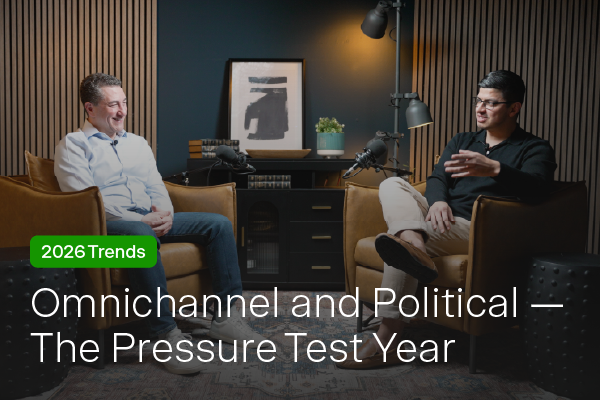
2026 Trends: Omnichannel and Political — The Pressure Test Year
In part three of a three-part series, Simpli.fi’s Chief Product & Technology Officer explains why omnichannel unification becomes non-negotiable in 2026, and why the upcoming political season is shaping up to be a wild one.
Writer: Weston Wheeler
Date: January 29, 2026
In 2026, the hardest part of marketing won’t be launching across more channels—it’ll be keeping everything working together once the year starts throwing curveballs. Consumers will keep bouncing between streaming, social, and search. Internal teams will keep being challenged to balance brand and performance. And then political season arrives, turning the market volatile: inventory tightens, prices spike, and redistricting can make “the right geography” a moving target.
In the final part of our three-part 2026 Trends series, inspired by conversations with Simpli.fi Chief Product & Technology Officer Michael Schoen, we’ll get into why omnichannel unification and political-year agility are the defining pressure test for 2026.

If you missed the first two blogs, catch up on them below:
- Part 1: Local Reach, Reimagined — How brands win one market at a time
- Part 2: CTV: The New Main Stage — Streaming as local reach, plus the organized chaos of sports
- Part 3: Politics and Omnichannel: The Pressure Test Year — The push to unify advertising channels coincides with a massive political year
In this final installment, we’re focused on a simple truth: 2026 won’t reward disconnected marketing. It will reward cohesion. The brands and agencies that can plan and execute across programmatic, social, and search/SEM with one consistent strategy will be better positioned to adapt when political pressure squeezes inventory, pushes prices upward, and makes select geography harder to target.
OMNICHANNEL IMPACT IF CAMPAIGNS ARE FRAGMENTED
Omnichannel is often mistaken for “running ads in more places.” But the real goal isn’t more channels—it’s one connected campaign built around shared outcomes across programmatic, streaming, social, and SEM.

The problem is that most “omnichannel” efforts still run like separate efforts. Brand and performance live on different teams. Programmatic sits in one platform and reporting workflow, while paid social and SEM search sit in others. Each channel gets optimized in isolation—so instead of a unified customer journey, you end up with fragmentation: inconsistent messaging, uneven frequency, duplicated spend, and measurement that’s hard to reconcile.
And in 2026, when attention is scattered and conditions can, and will, change fast, fragmentation isn’t just inefficient. It’s a massive liability.
BREAKING SILOS MEANS ALIGNING TO OUTCOMES
True unification isn’t “one dashboard.” It’s one strategy anchored to what the business is actually trying to accomplish—then using every channel to move the same audience toward that goal.
As Michael explains:
“Our goal is providing a comprehensive set of solutions… to run a comprehensive marketing campaign across all channels, both programmatic and non-programmatic — social, search, etc. — aligned in driving the business outcomes that our clients need.”
So what does “aligned to outcomes” look like in practice? It means you stop judging each channel by its own isolated metrics and start optimizing the entire mix based on the result you’re trying to drive—and where you’re trying to drive it:
- Multi-location foot traffic or sales goals: Instead of paid social optimizing purely to clicks and SEM optimizing purely to CPA, you align both to location-level outcomes—like store visits, appointment volume, or sales by market. Channels become different levers pulling toward the same location-based KPI.
- Awareness-to-action journeys that don’t break midstream: CTV and streaming video can be measured by more than completion rate; they can be tied to what happens next—site visits, search lift, retargeting performance, or store actions. Social and SEM don’t start from scratch—they pick up the same audience with sequential messaging built to convert.
- Outcome-led audience strategy (not channel-led targeting): Instead of building one audience for social, a different one for programmatic, and keywords in SEM that don’t match either, you define the audience based on the outcome (e.g., “in-market for a service within 10 miles of Location A”) and activate it consistently across channels—then adjust budgets based on which mix is driving strongest results..
- One measurement story your team can actually act on: If the brand effort is reporting “reach and video completion” while performance reports “CPA and ROAS,” nobody knows what to do next. Outcome alignment means reporting ladders up to shared goals—so optimization decisions are made together, not in parallel.
This outcomes-first mindset becomes even more important in a volatile year. When inventory shifts and pricing spikes, the temptation is to chase whatever looks cheapest or most available. But the advertisers who stay focused on outcomes—and optimize the channel mix around them—protect performance even when conditions fluctuate..
How can you prepare for the omnichannel shift in 2026?
- Stop planning by channel and start planning by outcome
- Coordinate programmatic + social + SEM around shared goals
- Measure and optimize towards performance as one cohesive journey, not disconnected touchpoints
Want a clearer path to true omnichannel unification in 2026? Explore Simpli.fi’s omnichannel solutions to see how advertisers can align their channels around shared business outcomes—and keep campaigns connected no matter the environment.
HOUSEHOLD-FIRST TARGETING IS RESILIENT DESPITE REDISTRICTING

Omnichannel complexity is one pressure test. In 2026, the upcoming political season adds another: geography itself becomes less reliable. Redistricting can shift boundaries mid-cycle, meaning a district plan that looks airtight today can become inefficient tomorrow—creating gaps in reach and wasted spend as maps change.
That risk is especially high if a campaign relies on static district targeting:
“If you’re relying on a static district map, you risk either missing important voters… or wasting valuable campaign dollars.”
So what’s the solution when the map won’t hold still? Anchor the campaign to something that does: the households themselves. Michael emphasized a household-first approach: build foundational targeting at the household level, then adjust district alignment quickly as decisions and boundary updates roll in.
Household-first targeting doesn’t remove complexity, but it protects campaign efficiency when lines shift mid-cycle. And in 2026, the real differentiator won’t just be targeting precision—it’ll be how fast you can adapt without losing momentum.
WHEN URGENCY IS NON-NEGOTIABLE, YOUR PARTNER MATTERS MORE THAN EVER
In political and advocacy work, “soon” isn’t a nice-to-have. It’s the job. There’s no “we’ll fix it next month” mindset when Election Day is impending and performance windows are measured in days, not quarters.
“In the political space, the urgency around these campaigns is really high. Campaigns have an end date. There’s a vote that’s being taken. So it’s really important that your partner is focused from a service perspective as well.”
This urgency changes what advertisers need from a partner. It’s not just about platform access or targeting options—it’s about operational speed: fast turnarounds, tight communication, and a client services cadence that can keep up with rapid pivots.
Because in a political year, the real-world obstacles stack up quickly:
- A redistricting change forces targeting adjustments a month before election day
- Inventory shifts overnight as spend surges in competitive markets
- Messaging priorities shift in response to the news cycle
- Budgets get reallocated with little warning
- Reporting needs to be actionable now, not weeks later
In that environment, “best-in-class” client service isn’t just a nice line in a pitch deck; it’s a critical performance advantage. The difference between hitting your goals and missing them can come down to how quickly your partner can adjust strategy, apply updates, and keep campaigns running cleanly under pressure.

NONPOLITICAL BRANDS CAN ALSO FEEL THE SQUEEZE
Unfortunately, this political volatility doesn’t stay contained to political budgets or two or three weeks before Election Day: it creates ripple effects across the entire market, often for months at a time.
“The fundamental challenge is the pressure it creates on inventory.”
When political spending ramps up, inventory tightens and pricing can become volatile — especially in contested markets. That pressure can disrupt even high-performance campaigns if they aren’t built to flex. CPMs climb faster than expected. Preferred placements get crowded out. Frequency becomes harder to manage, and delivery can shift away from the audiences and geographies you carefully planned around.
Even if your campaign is strategically sound, your efficiency can erode simply because the market is more competitive week to week. And for brands running always-on campaigns, that volatility doesn’t just impact one flight—it can cascade into pacing issues and missed goals across the quarter or year.
But the solution isn’t to sit out the year: It’s to plan for fluctuation and optimize around it. Build flexibility into budgets and targeting, diversify the mix so you’re not dependent on one inventory pool, and lean on a partner that can adjust your campaigns in real time as conditions change.
MULTI-LOCATION BRANDS WIN BY DEFINING OUTCOMES MARKET BY MARKET
Multi-location efforts add their own challenges as this volatility affects every market differently. An inventory squeeze in one DMA doesn’t mean the same thing in another. And when budgets, inventory, and competition shift unevenly, a single “national” optimization plan can end up over-investing in markets that are temporarily inefficient—or pulling out of locations that are still primed to perform.
That’s why multi-location success in 2026 starts with clarity: what outcome matters in each market, right now? For one location, the priority might be driving foot traffic. For another, it’s targeting competitor locations. For another, it’s promoting seasonally-appropriate products. Once outcomes are defined at the local level, channel strategy becomes more intentional: you can allocate budget where it has the best chance to hit goals, adjust pacing when costs spike, and shift tactics without abandoning the broader campaign.
“We look to understand the outcomes that they’re trying to drive for each of the individual locations and then optimize the inventory strategy and the pricing strategy… regardless of the fluctuations in pricing.”
In practice, that can mean protecting spend in a high-performing market even if another becomes temporarily expensive. It can mean tightening geo-targeting to focus on true service areas. It can mean leaning into more efficient inventory mixes or shifting flights so you’re not forced to buy at peak political pricing. In other words: volatility doesn’t have to derail performance—if the strategy is flexible, the optimization is market-aware, and the outcomes are clear.
THE 2026 TAKEAWAY
2026 is a pressure test year — and a cohesive and considered approach provides a huge advantage.
Omnichannel unification becomes non-negotiable as programmatic, social, and search/SEM need to operate as one coordinated strategy aligned to outcomes. At the same time, political and advocacy advertising brings volatility: redistricting turns geography into a moving target, and political surges create inventory and pricing pressure that affects everyone.
In 2026, the advertisers who win will:
- Align programmatic + social + SEM around shared business outcomes
- Break down brand vs. performance silos that fragment execution
- Use household-first strategies to stay resilient through redistricting changes
- Build flexible plans that can optimize through inventory and pricing volatility
Want the full story behind these shifts? Watch the 2026 trends interview with CPTO Michael Schoen—and explore how Simpli.fi helps advertisers unify omnichannel campaigns and adapt quickly during high-volatility moments.
 | Weston Wheeler
Sr. Content Marketing Manager | Simpli.fi Weston Wheeler is a strategic content marketing leader with roots in educational leadership and creative writing, fields that continue to shape his thoughtful, narrative-driven approach to brand storytelling. As Senior Manager of Content Marketing at Simpli.fi, he blends analytical insight with creative execution to craft compelling content that resonates across channels. With deep experience in digital advertising and a track record of success partnering with global agencies and brands, Weston endeavors to bring precision, empathy, and innovation to every project. |
Relevant Resources