
One Meal, Many Choices: Who’s Winning Customer Loyalty This National Cheeseburger Day?
See what Simpli.fi’s foot traffic data reveals about customer loyalty at major quick-serve restaurants throughout America.
Writer: Kerri O’Connor
Date: September 18, 2026
Estimated reading time: 5-minute read
What you’ll learn:
- The key findings from Simpli.fi’s latest Whose Cheeseburger Is It? report, highlighting the ongoing competition for customer loyalty among burger QSRs.
- Why measuring physical store visits is essential for understanding customer behavior beyond digital engagement.
- How foot traffic data and geo-fencing can help advertisers measure store visits and keep engaging customers at the right place.
September 18 is National Cheeseburger Day. A yearly opportunity for burger brands to capture the attention of customers deciding where to enjoy one of America’s most loved meals.
But this timely opportunity does not end with getting someone to buy a single cheeseburger on a novelty holiday. When the same customer is craving a cheeseburger on any other day of the year, what keeps them coming back to the same restaurant for more?
Since quick-serve restaurant (QSR) customers have dozens of options and no obligation to return to the same place, they may visit one brand today and choose a different one tomorrow. That makes customer loyalty to a QSR brand difficult to measure through digital engagement or a single store visit alone.
To better understand how customers choose between burger brands, Simpli.fi analyzed eight weeks of foot traffic across 20 U.S. metro markets and the top 20 burger QSRs. The findings are featured in Whose Cheeseburger Is It?, the latest report in Simpli.fi’s Loyalty in the Real World thought leadership series.
A customer’s first visit tells you where they went. Foot traffic can help reveal where they go next.
The report shares interesting findings on which burger brands have garnered the most loyalty, which are losing customers, and where those customers go when they switch.
Why Loyalty in the Real World Matters
Hungry customers may search for restaurants, browse menus, and interact with QSR advertisements online. But they cannot eat a website. For QSR brands, the customer action that counts most happens at a physical location.
So, when marketers aim to bring customers through the door, foot traffic data is essential for measuring how effectively an ad campaign achieves that goal. Without it, marketers may know that an ad was delivered or clicked, but not whether it influenced an actual restaurant visit.
The same principle applies across all brick-and-mortar industries. The U.S. Census Bureau reports that e-commerce accounts for 17% of all retail sales. That leaves approximately 83% of retail sales, or about $6.3 trillion annually, taking place inside physical stores.
For QSR marketers, franchise operators, and agency strategists, store-level measurement connects advertising activity to the offline actions that contribute to real business results. It can also provide insight into what happens after a customer visits one restaurant location.
Download Whose Cheeseburger Is It? to get a closer look at how customer loyalty plays out in the physical world, going beyond what digital engagement metrics show.
A CUSTOMER VISIT IS ONLY ONE PART OF THE STORY
While foot traffic data provides valuable insights on whether an ad campaign led to an actual store visit, it still does not show whether a customer is loyal, sampling several competitors, or likely to switch during their next dining occasion. A single visit to a restaurant only confirms that they chose the brand once.
This distinction matters for QSRs, where customers can choose from numerous nearby options and change brands with little friction. QSR brands need to not only understand who walks through their doors, but also whether those customers return or where they go to eat when they don’t.
Looking only at total store visits can leave an important part of the customer journey out of view.
The research featured in Simpli.fi’s latest report reveals a solid loyalty base among burger brands, but also shows that many customers remain open to switching.
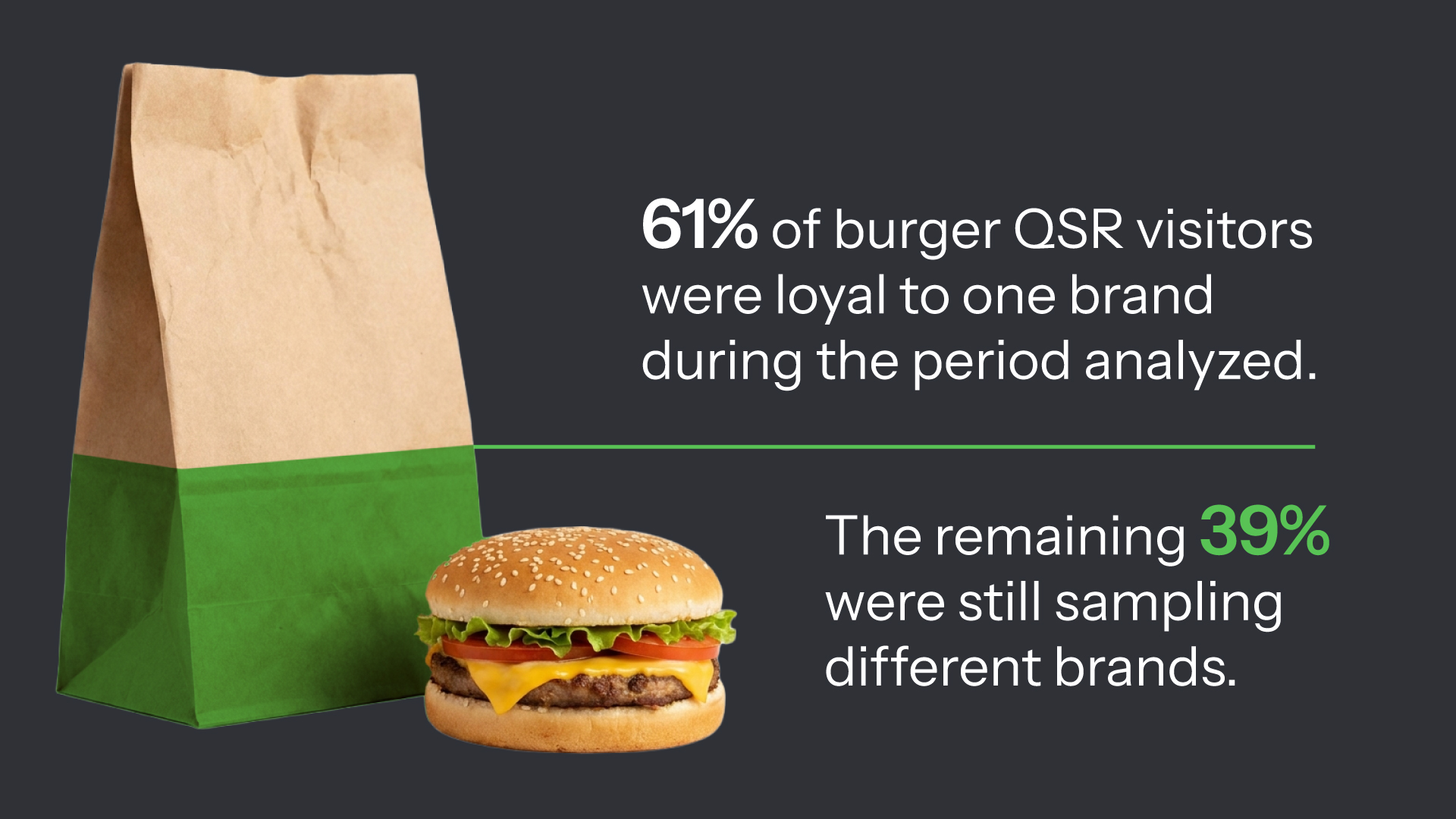
The data clearly shows that customer loyalty is both an existing strength and an ongoing competitive opportunity for burger brands. Get the Whose Cheeseburger Is It? report to know where loyalty is high and where customers may be moving to competitors.
LOYALTY CHANGES FROM CITY TO CITY
Burger preferences are not the same across America. Different cities show different levels of loyalty and different competitive dynamics.
In Dallas, Five Guys was the favorite burger brand. In Chicago, Burger King held the leading position. Denver boasts an overall 72% loyalty rate among burger QSR customers, while Chicago recorded a 55% loyalty rate.
These differences show why national averages do not provide an accurate look into what’s really going on in a specific region. A marketing strategy that works in one market may not address the customer behavior or competitive pressure present in another.
A brand may have a strong loyalty base in one city while facing more customer sampling in another. Franchise operators may also see different patterns across locations within the same market.
Market-level visibility can help QSR brands understand where loyalty is strongest, where customers are exploring alternatives, and where competitors may be gaining ground.
The full Whose Cheeseburger Is It? report explores these differences across major U.S. metro markets, giving advertisers a closer look at the local dynamics shaping customer loyalty.
HOW TO BUILD CUSTOMER LOYALTY WITH YOUR AD STRATEGY
The research data shows where customer loyalty toward burger QSRs currently stands. To act on these insights, we have listed two key approaches brands can integrate into their ad strategy to connect digital campaigns to physical visits and keep customers walking through their door.
1. Measure visits at the store level
For QSR marketers trying to get customers through the door, foot traffic data is an essential part of evaluating campaign performance. Without it, marketers may know that an ad was delivered or clicked, but not whether it influenced a visit to a restaurant.
Simpli.fi’s store-level measurement gathers foot traffic data to help brick-and-mortar advertisers connect ad spend to physical visits. The platform supports store-level measurement across multiple campaign types, including display, video, audio, native, and CTV. This gives QSR advertisers a more meaningful way to evaluate Return on Ad Spend (ROAS) by assessing how media investment relates to offline foot traffic.
These insights can help marketers understand whether campaigns are contributing to visits at specific restaurant locations, attracting new customers, or encouraging existing customers to return.
Building customer loyalty starts with understanding what is happening at each physical location.
2. Reach consumers showing real-world intent
Foot traffic data helps QSR marketers understand what happens after an ad is served, including whether it contributes to a visit to a restaurant location. Geo-fencing then adds the activation layer, helping brands reach relevant consumers based on where they are in the real world.
Simpli.fi’s Geo-Fencing solution allows advertisers to create custom boundaries around exact physical locations, including their own restaurants, competitor storefronts, and individual property lines. Powered by live location data and signal-level AI, the platform evaluates real-world activity to help advertisers engage consumers in the right physical context.
Together, foot traffic data and geo-fencing can support a more informed advertising strategy. Marketers can use foot traffic insights to understand customer visitation patterns, then use geo-fencing to stay connected with loyal customers, reach samplers visiting competitors, or build awareness around specific restaurant locations.
This approach helps brands move beyond measuring ad impressions and clicks. It shows them where customers go and provides an effective way to engage them through location-based targeting.
WHAT ADVERTISERS CAN LEARN FROM WHOSE CHEESEBURGER IS IT?
Customer loyalty to burger QSRs is not guaranteed. A substantial share of visitors are still exploring different brands, making customer switching an important part of the competitive picture.
While National Cheeseburger Day puts burger brands in the spotlight, customer loyalty is a year-round business challenge. To understand which brand is securing visits, where customers are sampling, and what the data reveals about QSR competition, advertisers need to go beyond the headline findings.
Read the Whose Cheeseburger Is It? report to explore Simpli.fi’s full analysis on customer loyalty across the burger QSR category.
 | Kerri O’Connor
Senior Manager, Content Marketing | Simpli.fi Kerri O’Connor is a strategic product marketer with deep expertise in digital advertising, audience engagement, and campaign performance. As a Senior Manager of Content Marketing at Simpli.fi, she leads go-to-market strategy, messaging development, and product adoption for innovative ad tech solutions. Kerri brings a strong background in programmatic media, digital strategy, and client enablement, translating complex industry trends into clear, actionable marketing. She excels at blending data with storytelling to drive results and help brands connect with the right audiences. A passionate storyteller and data-driven marketer, Kerri is committed to helping brands navigate the evolving digital landscape and maximize their marketing impact. |