
The Rise of Second Screen Advertising in the Streaming Era
Why attention is split and how smart brands are showing up on every screen that matters.
Writer: Luis Reyes
Date: April 30, 2026

As streaming continues to evolve, so does the way audiences engage with content. But the biggest shift isn’t just happening on the television screen.
It’s happening alongside it.
Today’s viewing experience is no longer a single-screen activity. Consumers are watching content while simultaneously engaging on mobile devices, searching for information, interacting on social platforms, or exploring products in real time.
This behavior, commonly referred to as second-screen usage, is reshaping how attention is distributed, how decisions are made, and how advertisers must approach media strategy. While often associated with younger audiences, this behavior is far more widespread. According to Statista, more than 46 million U.S. adults engage in second-screen activities while watching television.
Understanding how the second screen fits into the modern consumer journey is critical for brands looking to remain relevant in a multi-device environment.
WHAT IS SECOND SCREEN ADVERTISING?

Second screen advertising refers to engaging consumers across multiple devices at the same time, typically pairing a primary screen such as Connected TV (CTV) with a secondary device like a smartphone or tablet.
While the concept has existed for years, its role has expanded significantly as streaming adoption and mobile usage have increased.
Consumers are no longer moving from one device to another in a linear path. Instead, they are interacting across screens simultaneously—creating multiple opportunities for brands to engage, reinforce messaging, and drive action.
HOW SECOND SCREEN BEHAVIOR IS CHANGING CONSUMER ENGAGEMENT
Second screen usage is not simply a distraction from content. It is an extension of how consumers experience it.
Real-Time Search and Discovery
Viewers frequently turn to their phones to search for products, actors, brands, or topics related to what they are watching. This creates immediate opportunities for brands to capture intent beyond the primary screen.
Simultaneous Content Consumption
Consumers are engaging with multiple content streams at once, watching a show while browsing social media, reading reviews, or messaging others. This layered attention requires advertisers to think beyond a single-channel approach.
Increased Control Over the Journey
With access to information at their fingertips, consumers can move from awareness to consideration in seconds. The second screen accelerates the decision-making process and shortens the path to action.
For marketers, this shift isn’t something to resist. Rather, it’s something to embrace as an opportunity. Consumers are no longer experiencing brands in isolated moments, but as connected interactions across screens.
That brand message seen on the big screen doesn’t end there. It continues into its social feed, appears in search results, and resurfaces in the content audiences engage with next. From streaming TV to mobile scroll behavior, every interaction becomes part of a larger journey.
This is where an omnichannel approach makes the difference—connecting messaging across CTV, display, mobile, and social environments to meet users in motion and reinforce intent in real time.
With solutions built to activate across screens and capture engagement signals, like social interactions, site visits, and in-store activity, brands can move beyond fragmented impressions and create experiences that follow the consumer, not lose them.
This isn’t a distraction, it’s an extension.
And it’s already redefining how decisions are made.
WHY SINGLE-SCREEN STRATEGIES FALL SHORT
Traditional media strategies were built around a single point of engagement. In today’s environment, that approach creates gaps in the consumer journey.
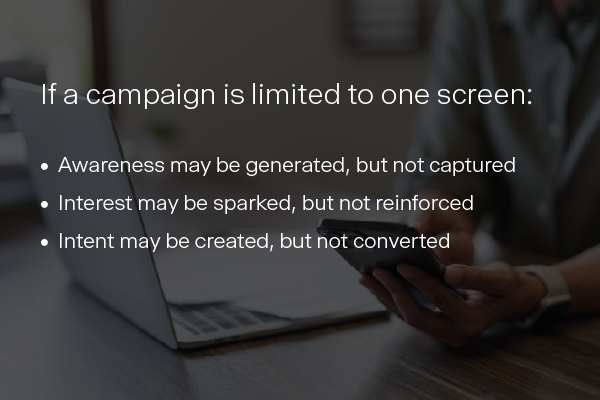
If a campaign is limited to one screen:
- Awareness may be generated, but not captured
- Interest may be sparked, but not reinforced
- Intent may be created, but not converted
The result is missed opportunities at the moments when consumers are most engaged.
To remain effective, advertising strategies must evolve to reflect how audiences actually behave, across devices, simultaneously.
HOW MARKETERS ARE ADAPTING TO A MULTI-DEVICE WORLD
As second screen behavior becomes the norm, marketers are shifting toward more integrated, data-driven strategies.
Omnichannel Execution
Campaigns are being built to operate across multiple environments simultaneously, including CTV, mobile, desktop, walled gardens, social media and programmatic channels. This ensures consistent visibility as consumers move between screens.
Cross-Device Messaging
Rather than delivering isolated impressions, advertisers are aligning messaging across devices to reinforce brand narratives and guide users through the funnel.
Behavior-Based Targeting
Targeting strategies are evolving beyond static demographics to incorporate real-time signals such as location, device usage, and engagement patterns.
Measurement Beyond Clicks
Marketers are placing greater emphasis on outcomes such as conversions, site visits, and in-store activity, rather than relying solely on clicks or impressions.
THE CHALLENGE OF EXECUTING SECOND SCREEN STRATEGY
While the opportunity is clear, execution remains complex without the right partner to provide the full picture.
Advertisers must navigate:
- Fragmented data across platforms
- Limited visibility into cross-device journeys
- Inconsistent attribution models
- The need to scale campaigns while maintaining relevance at the local level
These challenges often prevent brands from fully capitalizing on second screen behavior, despite recognizing its importance.
CONNECTING SCREENS TO DRIVE MEANINGFUL OUTCOMES WITH SIMPLI.FI
The shift to second screen engagement highlights a broader reality: consumer attention is no longer tied to a single device.
To effectively reach and influence audiences, brands must adopt strategies that connect experiences across screens—ensuring messaging is present, consistent, and measurable throughout the journey.
This is where platforms like Simpli.fi help bridge the gap.
By combining Connected TV, mobile, social media marketing and programmatic capabilities with location-based targeting, Simpli.fi enables advertisers to:
- Reach audiences across multiple devices simultaneously
- Align messaging across the consumer journey
- Connect digital engagement to real-world actions
- Scale campaigns nationally while maintaining local precision
At Simpli.fi we understand the second screen behavior is not a passing trend. It reflects a fundamental shift in how consumers interact with content and make decisions.
For advertisers, this means moving beyond isolated channels and toward connected, omnichannel strategies that reflect real-world behavior.
The question is no longer whether your audience is using a second screen.
It’s whether your strategy is built to reach them when they do.
REACH AUDIENCES ACROSS EVERY SCREEN THAT MATTERS
Consumers are engaging across multiple screens at once. Successful advertising strategies meet them at each point of interaction.
With the right approach, brands can move from fragmented attention to coordinated engagement, delivering messaging that follows the user, reinforces intent, and drives measurable outcomes.
Because in today’s media experience, effectiveness isn’t defined by presence on a single screen.
It’s defined by the ability to show up across all the screens that matter.
Let’s get your brand on every screen in the scene. Let’s talk: hi@simpli.fi
 | Luis Reyes
Sr. Manager of Content Marketing | Simpli.fi Luis Reyes is a dynamic leader in content marketing, recognized for strategically elevating brand presence and driving impactful results. As the Senior Manager of Content Marketing at Simpli.fi, he leverages extensive expertise gained from previous roles, including Senior Client Success Manager for national advertising agencies and enterprise clients, Marketing Content Creator at a leading healthcare services provider, focusing on brand mergers and project management, and Sales Account Manager at a prominent digital marketing firm, where he secured and managed national and regional digital marketing campaigns along with creative work. His diverse experience and forward-focused approach solidify his status as an authority in today’s competitive marketing landscape. |