
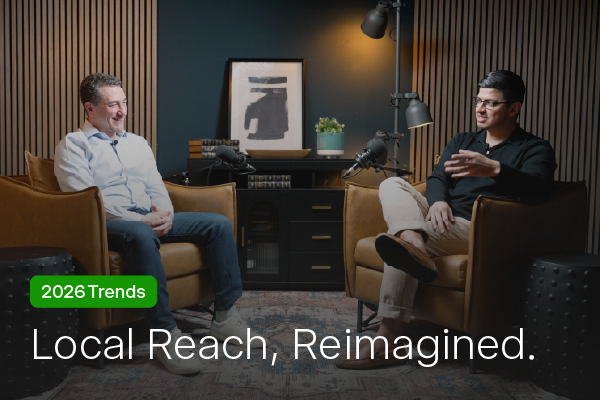
2026 Trends With CPTO Michael Schoen: Local Reach, Reimagined: How Brands Win One Market at a Time
In part one of a three-part series, Simpli.fi’s CPTO breaks down 2026 local advertising trends and how brands use data-driven, market-by-market strategies to scale local reach.
Writer: Weston Wheeler
Date: January 15, 2026
2026 is shaping up to be a pressure-test year for marketers. Not because one big thing is changing, but because everything is shifting at once. Streaming continues to rewrite “TV.” AI is reshaping how consumers discover and evaluate brands (often before they ever hit an actual website). Political and advocacy budgets are gearing up for a noisier, more competitive market. And across it all, one expectation keeps rising: marketing has to feel relevant at the local level: market by market, neighborhood by neighborhood.
We’ll be exploring these trends in a three-part 2026 Trends series, inspired by conversations with Simpli.fi’s Chief Product & Technology Officer, Michael Schoen. Each post breaks down the major shifts we see accelerating this upcoming year, along with the operational changes marketers will need to keep up.

- Part 1: Local Reach, Reimagined — how brands win one market at a time
- Part 2: CTV: The New Main Stage — streaming as local reach, plus the organized chaos of sports
- Part 3: Politics and Omnichannel: The Pressure Test Year — The push to unify advertising channels coincides with a massive political year
In this first installment, we’ll focus on why localized marketing is moving from a “nice-to-have” tactic to a baseline expectation in 2026 and why the fastest-growing national and multi-location brands are shifting toward a new operating model.
“Relevance used to be about who somebody was. Now it’s more about where somebody is.” Michael Schoen, Chief Product and Technology Officer, Simpli.fi
LOCALIZED ADS BECOME THE DEFAULT EXPECTATION, NO MATTER THE CATEGORY
For years, localization was treated like an “extra layer”: a store marketing add-on, a franchise initiative, or something you did when budgets allowed.
In 2026, that mindset no longer works.
Consumers increasingly expect messages that feel “made-for-here.” Not because they want novelty, but because their context is local: what’s nearby, what’s open, what’s in stock, what’s relevant to their area, and what they can act on quickly. The brands that keep running generic national messaging everywhere will feel less like leaders and more like background noise.
This is the year local stops being a specialty strategy and becomes the new standard for relevance.
Which brands are winning with localization today?
- Brands that align national strategy with local execution, ensuring consistency without sacrificing relevance
- Brands that activate real-time, location-based signals to inform creative, timing, and messaging
- Brands that design campaigns to scale market by market, not one-size-fits-all
- Brands that measure performance locally, then optimize continuously across regions
“From a consumer perspective, relevance is all about local.”
Every impression matters, and consumers expect brands to recognize their market, their context, and their realities. How a brand shows up locally signals that understanding.
In 2026, localization is no longer a competitive advantage; it’s the baseline expectation. The real differentiation comes from how effectively brands operationalize local at scale, without losing control, consistency, or cohesion.
And that’s where many national advertisers begin to feel the pressure.
NATIONAL BRANDS RACE TO “GO LOCAL”, WHETHER THEY’RE READY OR NOT
In today’s day and age, every brand wants to feel locally relevant but very few achieve a personal feel. Take iconic moments such as Netflix’s approach to the release of Stranger Things Season 5, where upside-down billboards made a nod to local audiences while building anticipation for the campaign’s objectives and season’s release. The problem many brands encounter is operational: most marketing organizations are not built to execute “national consistency and local truth” at the same time.
In 2026, that mismatch becomes one of the biggest sources of wasted spend.
Localization can’t be something you patch in at the end of the process. It has to be planned with the same intentionality as your audience strategy and channel mix; the performance impact happens at the market level.

The winning pattern looks like this:
Centralize what should be centralized: Messaging pillars, a modular unified creative message, measurement and reporting standards, and brand guardrails. This keeps the brand consistent across markets and prevents teams from reinventing the wheel every time a campaign launches.
Localize what must be localized: special offers, inventory-driven messaging, store priorities, service-radius realities, and the audiences most likely to convert in that market. This is where relevance is earned: local execution reflects what customers can actually do, buy, or experience right now.
Scale it intentionally: treat localization like an operating model, not a production scramble. That means packaging campaigns so they can be deployed market-by-market, establishing clear roles for centralized teams vs. local operators, and building repeatable workflows for testing, optimization, and reporting. This doesn’t happen across five campaigns; it happens across hundreds or thousands.
This is where 2026 becomes a dividing line. Brands that build localization as a system will scale faster and waste less while those that treat it as a last-minute customization step will stall.
THE BEST MULTI-LOCATION BRANDS WILL START OPERATING LIKE NETWORKS
As soon as you move from “one brand” to “many locations,” marketing becomes a different challenge. More storefronts don’t just add scale; they add complexity.
This means different stakeholders (franchise owners, store managers, local teams). Different inventories, different capabilities by market, different competitive realities and different local priorities. And even when the budget and strategy are centrally owned, execution becomes multi-dimensional fast.
In 2026, the best brands will respond by shifting operating models. They’ll behave less like a single company pushing one message, and more like a connected network of local nodes sharing the same brand DNA.
“Set a brand level overall strategy, defining guardrails, and then empower local decision makers.”
This isn’t about losing control. It’s about building a structure where local relevance is built in, not forced as an afterthought.
LOCAL REACH WILL BE POWERED BY A MODERN CHANNEL MIX AND A CRUCIAL DECISIONING LAYER
As the “where” becomes a central driver of relevance, the channels with strong geographic and contextual signals do more of the heavy lifting. In 2026, that mix is increasingly anchored by CTV, mobile, and digital out-of-home—not as isolated channels, but as a coordinated local reach engine.
CTV is becoming a premium canvas for local storytelling with modern precision. Mobile brings proximity and real-world behavioral signals. DOOH adds context at the moment of movement and decision.
But channel access alone won’t be enough. The winners in 2026 will pair that channel mix with a decisioning layer: a way to use behavioral, location, and other signals to continuously refine targeting, optimize performance, and measure outcomes at scale.
In other words, local reach succeeds when relevance can be activated and improved continuously, not set once and left alone.
THE 2026 TAKEAWAY
Localized marketing is becoming the price of entry for relevance, particularly for national and multi-location brands trying to win market by market.
The brands that win fastest in 2026 will:
- Treat localized messaging as the baseline expectation
- Systematize localization instead of patching it in
- Operate like networks (guardrails + local empowerment)
- Build local reach on modern channels powered by decisioning and measurable outcomes
Want the full story behind these shifts? Watch our 2026 trends interview with CPTO Michael Schoen and subscribe to the three-part series. Up next: CTV: The New Main Stage and why streaming is redefining performance and reach.
Ready to launch your 2026 marketing plan with local precision? Connect with Simpli.fi to explore a strategy built for market-by-market intention, scalable execution, and measurable impact.
 | Weston Wheeler
Sr. Content Marketing Manager | Simpli.fi Weston Wheeler is a strategic content marketing leader with roots in educational leadership and creative writing, fields that continue to shape his thoughtful, narrative-driven approach to brand storytelling. As Senior Manager of Content Marketing at Simpli.fi, he blends analytical insight with creative execution to craft compelling content that resonates across channels. With deep experience in digital advertising and a track record of success partnering with global agencies and brands, Weston endeavors to bring precision, empathy, and innovation to every project. |
Relevant Resources