Awards Season Has Entered the Streaming Era
What the 2026 awards landscape tells us about streaming’s dominance — and why it matters for marketers.
Writer: Weston Wheeler
Date: March 10, 2026

For decades, the film awards season reinforced a familiar hierarchy. Studios launched films in theaters, measured success by box office momentum, and leveraged carefully timed release windows to build prestige through festivals and awards circuits.
One streaming revolution later, that formula has been rewritten: streaming platforms command the majority of audience attention, and awards season reflects that reality.
FROM DISRUPTION TO DOMINANCE: STREAMING TAKES CENTER STAGE
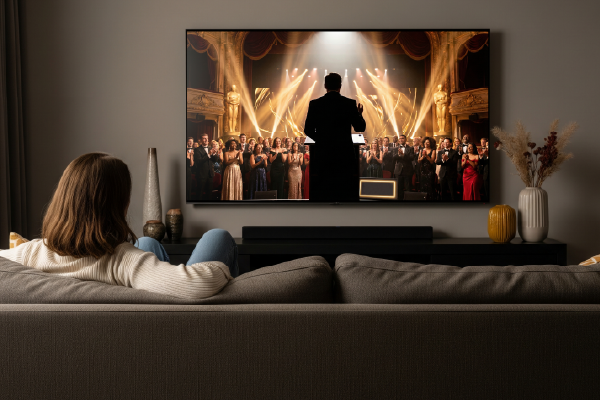
Streaming-first publishers are now central to the Oscars conversation: Netflix entered this year’s nominations as the second-most nominated studio overall, driven in part by its high-profile contender Frankenstein, which secured nine nominations across major categories. Apple Original Films, another streaming-first studio, also reinforced its growing awards footprint with F1, a Best Picture contender that earned four nominations and further solidified Apple’s position as a prestige studio in its own right.
Beyond streaming publishers, films backed by major studios are also quickly migrating into streaming ecosystems. The most nominated film of the year, and of all time, Sinners, earned 16 nominations and is streaming on HBO Max, where subscribers can also find One Battle After Another, which followed closely with 13 nominations. Together, these titles illustrate a broader reality: whether born on streaming platforms or moving rapidly into them, the most celebrated films of the year ultimately live inside streaming environments.
Legacy studios are still present, but the dominance of streaming-affiliated films atop the nominations list — and the critical role of streaming in film distribution — reflects how deeply streaming has reshaped industry economics. HBO Max’s parent company, Warner Bros. Discovery, landed the highest total nominations of any studio this year (30 nominations), and the service has become a key destination for post-theatrical streaming runs that sustain long-tail audience engagement and subscriber retention.
What’s notable isn’t just that streaming platforms appear — it’s that their presence now feels institutional rather than anomalous.
Streaming-backed films are not outliers in awards season; they are leaders.
FOLLOWING IN TV’S FOOTSTEPS
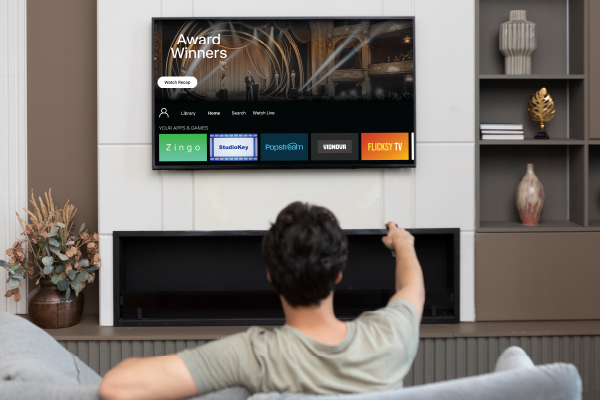
If streaming’s prominence at the Oscars seems significant, it’s because it mirrors patterns that have already played out in other sectors of entertainment.
Television was impacted by the streaming awards shift earliest and, by 2025, streaming dominance was all but absolute. At the 77th Primetime Emmy Awards, the top “networks/platforms” were overwhelmingly streaming-led: HBO/HBO Max and Netflix tied for the most total wins with 30 each, while Apple TV+ followed with 22 wins. The nominations scoreboard told the same story: HBO/Max led with 142 nominations, Netflix followed with 120, and Apple TV+ earned 81.
But this wasn’t just platform-level dominance; it showed up in breakout titles, too. Apple TV+’s The Studio set a new record for the most Emmy wins, 13, by a comedy series in a single season, surpassing the previous record of 11 held by The Bear (which was also produced by a streaming-first platform, Hulu.) Meanwhile, Netflix’s Adolescence brought home 8 awards and anchored Netflix as a prestige contender.
And the pattern extends beyond visual media. According to the 2025 RIAA mid-year report, streaming accounted for 84% of U.S. recorded music revenue, driven by more than 105 million paid subscriptions. Music streaming isn’t just bigger than physical formats; it is the format.
Across mediums, the story is consistent: ownership-based consumption is contracting while access-based streaming dominates both consumption and revenue. Film is simply the latest major storytelling medium where these effects have resulted in award recognition.
AUDIENCE ATTENTION FIRST, THEN THE AWARDS

Awarding entities don’t create shifts in entertainment; they confirm them, recognizing where audiences have already moved. And by nearly every measurable standard, that movement has decisively shifted toward streaming.
In May 2025, streaming reached 44.8% of total television usage, for the first time surpassing broadcast and cable combined. By the end of the year, that share climbed to 47.5%, demonstrating a sustained trajectory that isn’t slowing down.
That isn’t incremental growth. It represents a structural reallocation of how audiences spend time with content.
When the dominant share of all screen time is consumed inside streaming ecosystems, every downstream decision — from talent deals to awards campaigning to marketing strategy — adjusts accordingly. Creative talent builds around platforms that can deliver large, measurable, global audiences. Production budgets flow where engagement and scale are highest. Distribution strategies optimize for on-demand access.
Awards recognition simply follows that gravitational pull.
Streaming’s prominence in awards season isn’t a creative anomaly. It’s the natural outcome of where audiences already invest their time.
WHAT THIS SHIFT SIGNALS FOR MARKETERS
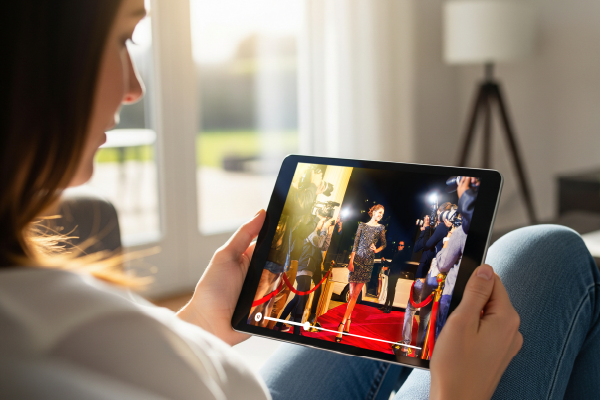
For marketers, the awards season landscape isn’t just an entertainment story — it’s a media strategy signal.
Streaming has become the center of cultural gravity, and that has several implications worth noting:
- Streaming environments house the premium cultural moments. Awards-season films and TV shows generate the conversations, media coverage, and appointment viewing that define cultural relevance. Aligning with streaming placements means aligning with those moments where attention is concentrated, an increasingly difficult challenge in the world of fragmented viewing.
- Strategic planning must reflect where attention already lives. Streaming is no longer a complementary line item in a video plan. When audiences spend the majority of their screen time inside streaming ecosystems, marketers must prioritize those environments first, then layer other channels accordingly.
- Streaming offers targeting and measurement advantages that traditional broadcast doesn’t. Household-level reach, geographic and demographic precision, frequency controls, and measurable outcomes allow advertisers to align with premium content and drive accountable performance.
In short, streaming is no longer just another channel. It is where premium content, cultural relevance, and measurable attention converge. Successful marketing strategies must reflect that shift.
THE RED CARPET, COMING SOON TO STREAMING
As a further proof point of streaming dominance, the Academy Awards themselves are shifting distribution models. Beginning in 2029, the Oscars will stream exclusively on YouTube, representing a decisive move toward prioritizing digital audiences over linear broadcast.
The Academy Awards remain one of the most visible moments in the entertainment calendar. This year, as streaming-backed films and studios sit at the top of nomination lists, that visibility doubles as validation of where audiences truly live.
When the institutions built for broadcast begin restructuring around streaming delivery, the shift is no longer a passing trend. It is a redefinition of how entertainment is distributed, consumed, and monetized.
Streaming won the audience first. Now the prestige of industry accolades — and the institutions behind them — are following.
For marketers, the conclusion is straightforward: streaming is no longer just another channel in the mix. It is the dominant environment where cultural moments originate, audiences concentrate, and measurable attention lives.
The red carpet still represents excellence. But in 2026, excellence lives in streaming.
Ready to bring your brand into the streaming era? Reach out to us at hi@simpli.fi.
 | Weston Wheeler
Sr. Content Marketing Manager | Simpli.fi Weston Wheeler is a strategic content marketing leader with roots in educational leadership and creative writing, fields that continue to shape his thoughtful, narrative-driven approach to brand storytelling. As Senior Manager of Content Marketing at Simpli.fi, he blends analytical insight with creative execution to craft compelling content that resonates across channels. With deep experience in digital advertising and a track record of success partnering with global agencies and brands, Weston endeavors to bring precision, empathy, and innovation to every project. |